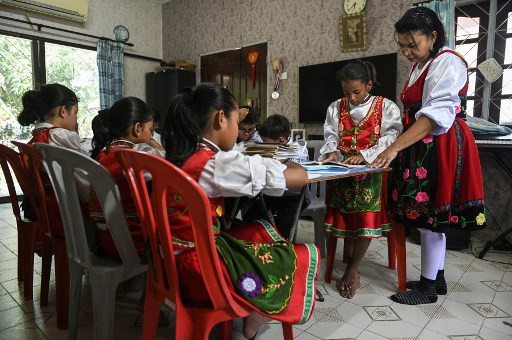
On a humid Friday evening in Melaka, a living room hums with the rhythm of a fading tongue. Plastic chairs line the tiled floor as a small group of children repeat Kristang phrases after their teacher.
“Bonitu.” “Obrigadu.”
Their voices wobble, then steady, especially when a grandmother in the corner beams proudly at her grandson for getting it right.
The class is run by Sara Santa Maria, one of the few remaining speakers keeping Papia Kristang – a Portuguese-Malay creole, alive. Every week, she opens her home to teach the words she grew up hearing so they don’t disappear with her generation[1].
Across Malaysia, scenes like this echo quietly in dozens of homes and classrooms. The country’s 138 living languages form a kaleidoscope of heritage, yet nearly 80% are endangered. Their survival now rests on how often children still speak them.
The Cost Of Losing A Language
Scenes like Sara’s living room class are small flames of hope, but they also reveal how much hangs in the balance.

Malaysia is among the most linguistically diverse nations in the world, home to roughly 138 living languages spanning the Malayic, Austroasiatic and Bornean families[2]. Yet studies show that nearly 80% are endangered[3].
When a language fades, it’s never just vocabulary that vanishes. It carries with it knowledge of forests and rivers, metaphors that once shaped folklore, and humour only intelligible in a specific dialect.
Languages are not just words – they are worlds. When a language disappears, we lose a way of understanding the world and connecting generations. – UNESCO[4]
In Sabah and Sarawak, many indigenous languages hold ecological vocabulary describing plants, rivers and animal behaviour found nowhere else[5].
In Melaka, Peranakan families once used Baba Malay to pass down rituals, jokes and recipes. Across the peninsula, small tongues safeguard memories of identity and belonging.
Language is an inheritance. And when the link between generations breaks, reviving it becomes a race against time.
Thriving Native Languages

Malaysia’s linguistic landscape stretches across coasts, mountains and settlements, each shaped by its own history and voice.
- Semai (Pahang & Perak): An Orang Asli language spoken by about 60,000 people, still passed down to children in certain villages and schools that offer Semai as a subject[6].
- Kristang (Melaka): A Portuguese-Malay creole from the Portuguese Settlement, now spoken by only 1,000–2,000 people[1].
- Baba Malay (Melaka): A Peranakan creole blending Malay and Hokkien, spoken mostly by the elderly, with fewer than 1,000 fluent speakers[7].
- Iban (Sarawak): A thriving heritage language with an estimated 750,000 speakers, recognised as an SPM subject and used in local broadcasting[8].
- Mendriq (Kelantan): A critically endangered Aslian language spoken by fewer than 300 people in Gua Musang[9].
- Punan Batu (Sarawak): A Bornean language with fewer than 30 known speakers, limited to a handful of communities.
- Jahai (Perak & Kelantan): An Orang Asli language spoken by about 1,000 people. Still learned by children, although considered vulnerable[10].
- Mintil (Pahang): A critically endangered Aslian language from the Lanoh subgroup, with around 400 speakers across central Pahang[11].
Why Do Languages Fade Away in Malaysia?
Languages rarely disappear overnight. They fade slowly, generation by generation, as daily spaces stop requiring them.
In Malaysia, the “prestige economy” of languages plays a critical role. Children grow up learning Bahasa Melayu and English as the keys to education, employment, and mobility. Within Chinese communities, Mandarin carries high social and economic value. Heritage tongues, by contrast, are often perceived as sentimental but “less useful” in modern life.
Dr. Paolo Coluzzi, a sociolinguist at the University of Malaya who studies language vitality and the sociopolitical dynamics behind language shift, describes how English is placed at the top of this prestige hierarchy:
English has been placed in the first position [of prestige] in Malaysia. Standard Malay also enjoys quite high prestige and shares with English many high domains. – Dr Paolo Coluzzi[13]

Schooling and media exposure further accelerate the shift. National curricula emphasise Malay and English, leaving little room for minority-language instruction. Young speakers may understand their ancestral language but hesitate to use it, especially outside the home[12].
Urban migration and mixed-language households strengthen this shift. Families moving to cities or marrying across ethnic lines often default to Malay or English for convenience. Over time, words of affection, jokes and prayers are replaced.
Among indigenous groups, resettlement and assimilation policies have also disrupted transmission. The creation of Rancangan Penempatan Semula (RPS) settlements in the 1970s and 80s mixed Orang Asli tribes with different dialects, weakening distinct linguistic identities[13].
As Dr Paolo Coluzzi observes,
Even the most vital minority languages are experiencing a slow but steady shift—the younger generation uses them less, even when they still understand them.[13]
Language Warriors In Modern Day
#1: Kristang (Melaka): Children as Learners
Every Friday evening, the Portuguese Settlement’s narrow lanes fill with familiar chatter as children shuffle toward Sara Santa Maria’s home, a place that has quietly become a frontline for language survival. Inside, the living room turns into a lively classroom. Sara introduces greetings, blessings, and everyday expressions in Papia Kristang, the Portuguese-Malay creole her parents once spoke with ease.
These lessons are free and entirely community-driven, rooted in a collective desire to keep a 500-year-old creole alive despite having only 1,000–2,000 speakers left today[1]. For many of these children, this is their first real encounter with the language of their ancestors.
At Universiti Malaya, linguist Dr. Stefanie Pillai strengthens these grassroots efforts through the Beng Prende Portugues Malaká book project. Her team develops beginner-friendly materials, recordings, and children’s resources that volunteer teachers can use in homes across the settlement. What began as a handful of informal classes has now grown into an organised network of micro-classrooms, each one a tiny bulwark against linguistic extinction.
The community has to be involved… They must decide whether they want their language to live, or not. – Dr Stefanie Pillai[14]
For Kristang, the fight for survival begins with children repeating simple words, hesitant at first, then stronger, restoring a language one phrase at a time.
#2: Baba Malay (Melaka): Children as Reconnectors

At the Baba & Nyonya Heritage Museum, Melissa Chan grew up surrounded by heirlooms: porcelain bowls, wooden cabinets, embroidered shoes, black-and-white portraits. Yet the most precious link to her heritage, the Baba Malay language, was the one she never inherited.
My memories of Melaka were of … my grandmother speaking a form of Malay that I did not understand. – Melissa Chan[15]
As elders passed on, so did much of the language. Today, Baba Malay has fewer than 1,000 fluent speakers[7], most of them elderly. For many younger Peranakans like Melissa, heritage identity was preserved through food, furniture, and folklore, but the language slipped through the cracks.
Driven by this loss, Melissa and her father co-authored Stories of One Malaccan Family to document the idioms, phrases, and memories they feared would fade with time[15]. Their work mirrors a wider movement: families recording oral histories, hosting intergenerational gatherings, and performing Dondang Sayang, the Peranakan love ballad recognised by UNESCO.
In these moments, over festival dinners and museum tours, children encounter the sounds of Baba Malay not as relics, but as living echoes. Their role is not just to learn the language, but to reconnect the threads of a community whose identity has always lived in the space between cultures.
#3: Kelabit (Sarawak): Youth as Cultural Transmitters

Up in the Kelabit Highlands of Bario, where mountain mist drapes longhouses at dawn, young filmmaker Sarah Lois Doras returned home with a camera and a question: What does it mean to inherit a language?
Her documentary Songs of the Highlands captures Kelabit elders singing ancient melodies and recounting stories that once shaped community life. The film’s selection at the 45th Annual Hawaiʻi International Film Festival (HIFF45) brought the voices of a small highland community into international view, amplifying a heritage that rarely reaches large audiences[16].
For Sarah, filmmaking became an act of rediscovery.
I realised how far removed our generation is from that reality. Through film, we can’t live it, but we can remember. And remembering is powerful. – Sarah Lois Doras, filmmaker[16]
The Kelabit language, with an estimated 6,000 speakers, is among the more vibrant heritage tongues in Sarawak, but it remains vulnerable, especially as young Kelabit migrate to cities. Sarah’s work reflects a new kind of language activism: youth using digital storytelling, film, and social media to make ancestral languages relevant again.
By turning memory into media, the next generation becomes both student and guardian.
#4: Mendriq (Kelantan): Children as Keepers of a Last Tongue

Deep in the forests of Gua Musang, Ida Terang is fighting a quieter, more fragile battle. As one of the few remaining fluent speakers of Mendriq, a critically endangered Aslian language with only a few hundred speakers left[9], she teaches her children and neighbours in the most natural classroom, daily life.
In the forest, she names plants in Mendriq. At home, she tells stories by firelight. During gatherings, she greets children in the language she fears may vanish within a generation.
Experts warn that Mendriq could become extinct within 20 years without strong revitalisation efforts. Yet Ida continues speaking it at home, knowing that as long as her children use the words, the language stays alive, even softly.
Her work is not part of a formal curriculum or cultural programme. It is survival by love and insistence, a mother keeping a last tongue alive through repetition, storytelling, and the rhythms of everyday life.
Keeping The Voices Alive
Language revival doesn’t happen by accident. It flourishes when families, schools and media share a common goal: to keep words in use. Across Malaysia, small but powerful systems are creating room for endangered tongues:
- Digital documentation: Projects like WikiKata, led by Wikimedia Malaysia and IIUM, allow youth and indigenous communities to upload vocabulary and audio to Wiktionary. So far, 628 entries and 276 pronunciations have been added[17].
- Classrooms that count: The Ministry of Education now offers Iban, Kadazandusun and Semai as elective SPM subjects, encouraging students to study their heritage languages. At the same time, UPSI – The Faculty of Languages and Communication at Universiti Pendidikan Sultan Idris, offers academic programs, including a Diploma in Ethnic Languages, for languages such as Kadazandusun, Iban, and Semai.
- Broadcast and airwaves: RTM’s Wai FM Iban and Asyik FM (airing in Semai, Temiar and Jakun) bring minority languages to daily listeners. Stations like Sabah V FM add Kadazan-Dusun content. Youth-led podcasts like Penang Hokkien and young influencers like Sydney Atin, who talks about the Dayak culture and heritage, are keeping heritage alive online.
- Identity on paper: The recent recognition of “Baba Nyonya” as an ethnic category on birth certificates is a symbolic win for heritage identity[18]. Still, elders remind us that a name alone cannot preserve a tongue; it must live in conversations, classrooms and stories.
From radio to policy papers, from phone screens to family homes, these are the bridges keeping Malaysia’s voices alive and the pathways for the next generation to speak them forward.
The Voice Of The Next Generation
As evening softens, Sara’s class in the Portuguese Settlement ends with laughter. The children stand in a loose circle, singing a Kristang song about the sea. One little boy tugs his mother’s sleeve and proudly teaches her a new word he learned that night.
“Obrigadu.” Thank you.
The future of Malaysia’s languages lies not in the past, but in how they are lived today. To keep this heritage alive, children must speak, sing and dream in the words once spoken by their ancestors.
Each phrase passed down, each word repeated with pride, keeps history alive in a way no archive can.
Languages go beyond mere communication; they embody a community’s culture, practices and way of thinking. – Dr Stefanie Pillai, linguist at University Malaya[14]
When young voices echo old ones, they remind us that a language never truly dies; it simply waits to be spoken again.
Explore Our Sources:
- Tham, L. (2023). Sara helps to keep Melaka Portuguese language alive. Link
- UNESCO. (2023). Atlas of the world’s languages in danger. Link
- Coluzzi, P. (2017). The Vitality of Minority Languages in Malaysia. Link
- UNESCO. (2025). ‘Languages are not just words—they’re worlds’: UNESCO Bangkok celebrates 25 years of International Mother Language Day. Link
- Joshi et al. (2004). Indigenous systems and ecological knowledge among Dayak people in Kutai Barat, East Kalimantan – a preliminary report. Link
- Chin, K, W, J. (2021). Mother tongue use in informal indigenous education: The perspectives of Orang Asli volunteer teachers in Peninsular Malaysia. Link
- Lee, D. (2020). Peranakan Malay: Keeping The Language Alive. Link
- Borneo Dictionary. (2025). Iban Language. Link
- The Star. (2023). Saving Mendriq language. Link
- Ethnologue. Jehai. Link
- Ethnologue. Mintil. Link
- Ying et al. (2015). Language Vitality of Malaysian Languages and Its Relation to Identity. Link
- Lin, K, G. (1994). Resettlement and Nutritional Implications: the Case of Orang Asli in Regroupment Schemes. Link
- Chen, G. (2024). Compilation key to preservation. Link
- Mah, K. (2018). Growing up Peranakan: Stories of one Malaccan family. Link
- Jayne, T. (2025). Malaysian Short Film On Kelabit People Selected For Prestigious International Festival. Link
- IIUM. (2025). WikiKata Preserving Indigenous Languages. Link
- Murali, R. (2025). Baba Nyonya identity now recognised on birth certificates. Link